


Dhigurah’s reef forms the northern edge of the South Ari Marine Protected Area, one of the few places on earth where whale sharks are recorded in every month of the year. The rules for being in the water with them were tightened in 2025 and 2026. This is what that means for you, written by the people who take the boat out.
Yes. Dhigurah is one of the main bases for whale shark snorkelling in the South Ari Marine Protected Area, where the animals are present year-round. Trips are run as snorkelling. You keep at least 3 metres from the head and body and 4 metres from the tail, never touch, and never cross in front of the shark. Boats must be registered, stay 15 metres away and take turns: no more than six boats in the 250 metre zone around a shark, and 15 minutes in the water when others are waiting.

Quick answer: Why Dhigurah is a whale shark base
Dhigurah is located at the bottom right corner of South Ari Atoll. Even though the whale sharks swim all around South Ari, we’re located pretty central to their path and an easier trip away for the sightings, whether it may be west or north.
What SAMPA is and why whale sharks are here
The South Ari Marine Protected Area, SAMPA, is a protected zone in Alif Dhaal atoll, described in the official guide material as the largest protected area in the Maldives, declared in 2009 and running 1 km out to sea from the reef crest of every island between the northwest corner of Rangali and the northern tip of Dhigurah’s reef. Whale sharks aggregate here rather than passing through. The official study material cites more than 726 individually identified whale sharks and more than 8,000 recorded encounters (Big Fish Network, 2024). Most are young males, and sharks are rarely seen here again once they grow past about 8 metres, so SAMPA appears to be a nursery stage in their lives.
What the 2025 and 2026 rules changed
The updated SAMPA framework tightened the practical mechanics of encounters. The provisions that affect visitors most directly:
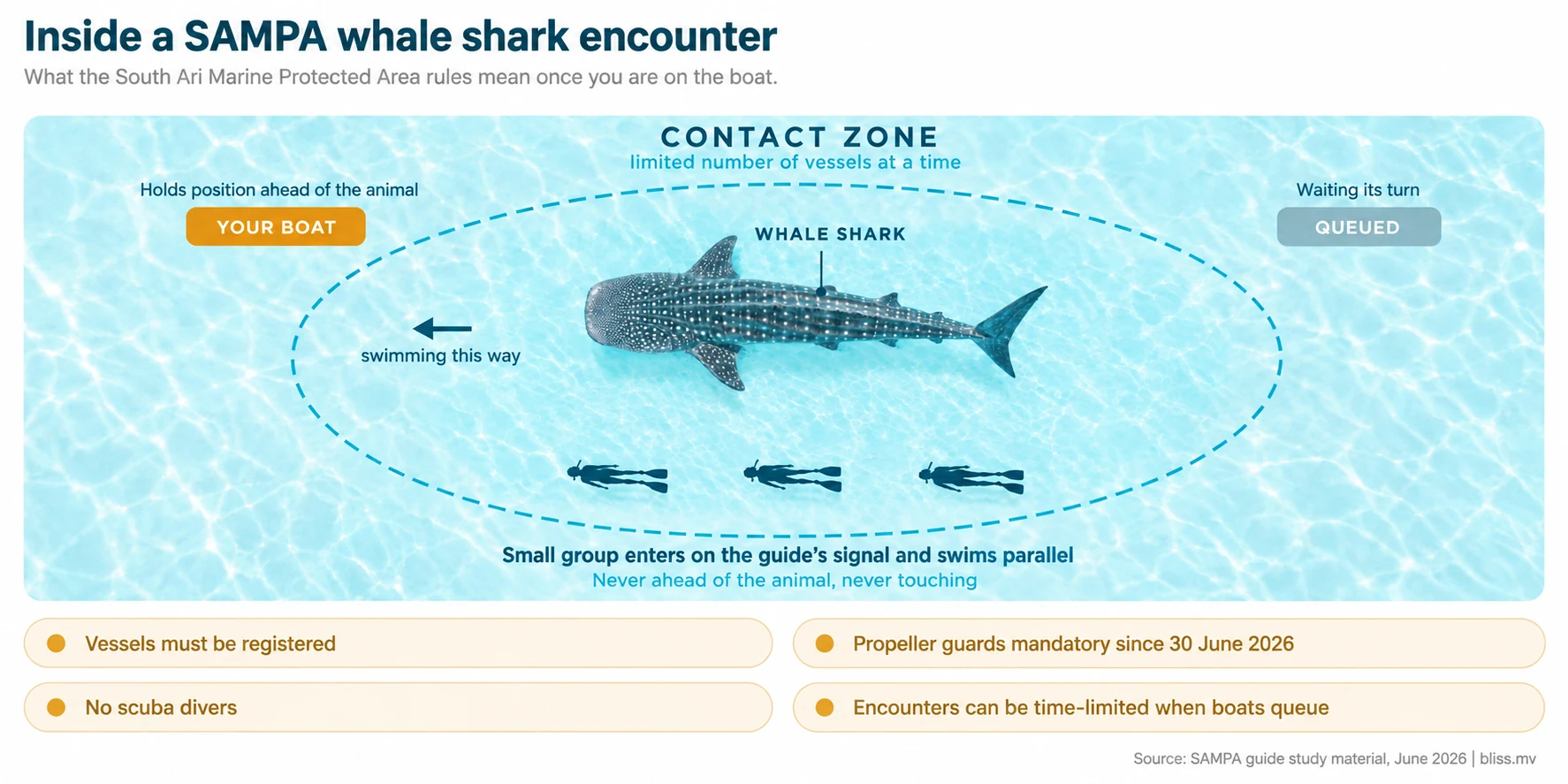
- Vessel registration. Boats used for snorkelling and diving must be registered with the Environmental Protection Agency and fly its flag in the area. Each trip is booked with the SAMPA rangers a day ahead and shares its live location while inside the boundary.
- Propeller guards. Mandatory on every snorkelling and diving boat: speedboats since 30 April 2025, all other boats since 1 February 2026. They are a direct response to propeller injuries on whale sharks.
- Contact zones. The 250 metre circle around a whale shark or manta is a contact zone. Only six boats may be inside it at once, one of them the rangers’, so your boat may hold off and wait its turn. Boats keep 15 metres from the shark, never pass over it or cut across its path, and put the engine in neutral if it swims closer.
- Timed encounters. When other boats are queuing, you get 15 minutes in the water so everyone has a turn. Swimming with the sharks is allowed only between 6 am and 6 pm, with at most 60 people in the water from one boat, guides included.
- Certified guides. Every group is led by a SAMPA Guide who has passed the EPA exam and holds rescue diver and first aid certificates, with no more than six guests per guide.
- No entry fee, for now. Visiting SAMPA is currently free, though the government can introduce a fee.
What those rules mean for a guest on the boat
In practice: expect to wait, and expect the wait to be the sign of a well-run trip rather than a badly organised one. A boat that pushes into a contact zone ahead of its turn, drops six people on top of an animal, or chases a shark that has turned away is breaking the rules and degrading the encounter for everybody, including you. Your actual in-water time may be shorter than you imagined and the animal will be calmer for it.
What a real excursion is like
- Briefing and departure. Your guide explains the rules before the boat leaves, not when you are already in the water. Boats usually leave at 8:30 in the morning, and the trip lasts four to five hours.
- Spotting. Crew scan from height for a shadow or a dorsal fin. This is the part that takes patience, and it is mostly quiet waiting.
- Positioning. The boat waits its turn in the contact zone, then stops at least 15 metres from the shark, to one side and never across its path.
- Entry. You slip in rather than jump, in a small group, on the guide's signal. If the operator is aggressive about ensuring you see a whale shark, make sure to communicate that an ethical, responsible and safe experience is important to you.
- The encounter. You swim parallel to the animal, at least 3 metres from its head and body and 4 metres from its tail, never ahead of it, never touching. It may last under a minute or several.
- Return. Back aboard promptly so the next boat can take its turn.
- Managing Expectations If the area is overcrowded, it may be safer and better to continue on to see if another shark can be spotted.
Best time, weather and visibility
Because the animals are in the protected area year-round, timing is about conditions rather than season. Calmer seas make spotting easier; heavier weather makes it harder, which is why a trip can be postponed. The Maldives Meteorological Service puts the drier northeast monsoon at roughly January to March and the wetter southwest monsoon from about mid-May to November, with April and December transitional.
How to choose a responsible operator
Questions to ask before booking
| Ask this | A good answer sounds like | Walk away if |
|---|---|---|
| Is your vessel registered for SAMPA? | Yes, and the boat flies the EPA flag | They do not know what you mean |
| Is the guide SAMPA certified? | Yes, with no more than six guests per guide | They are not sure what that is |
| Do you have propeller guards fitted? | Yes, they are required on every SAMPA snorkelling and diving boat | They treat it as optional |
| How many snorkellers enter at once? | A small group, in turns, on the guide's signal | "Everyone goes in together" |
| What happens if we do not find one? | A clear, stated policy | Vague promises of guaranteed sightings |
| Do you ever chase an animal that swims off? | No, we let it go | Any version of "we follow it" |
Swimming ability, children and safety
You need to be comfortable in open water with a mask and fins, able to enter from a boat and swim steadily for a few minutes without panicking. You do not need to be a strong swimmer or a diver. Flotation can usually be provided. At Bliss, children can join from age four, depending on how well they swim.
If you are travelling with children, our activities team will tell you honestly whether a particular child is likely to enjoy the trip, and we would rather say no than put a nervous eight-year-old in deep water beside a ten-metre animal.
Photography etiquette
- No flash and no lights. Both are banned in SAMPA because they startle the shark.
- No selfie sticks. They are banned around whale sharks.
- Flying a drone? Keep it at least 30 metres above the water and in sight, for no more than an hour at a time. We don’t recommend flying a drone from a boat unless you have a large open upper deck to safely land it. There have been many incidents of tourists losing their drones to the ocean due to a collision with the boat.
- Never let the housing be the thing that closes the distance for you.
- Film in short bursts and actually watch the animal, people routinely return having seen the whole encounter through a screen.
- If getting the shot would require cutting in front of the shark, you do not get the shot.
Frequently asked questions
Can you scuba dive with whale sharks in SAMPA?
Whale shark trips are run as snorkelling, because the sharks are usually near the surface. Scuba diving is allowed in SAMPA, but in separate zones away from the snorkelling boats. If a whale shark turns up on a dive, divers stay 20 metres away and do not chase it.
What month is best for whale sharks in Dhigurah?
There is no single best month, because they are present all year. Choose your month on weather and sea state instead, calmer water makes spotting easier.
How close can you get?
At least 3 metres from the head and body and 4 metres from the tail, approaching slowly from the side so the shark can see you. If it is deeper than you, keep 20 metres away and let it rise rather than diving down to it. Boats stay 15 metres back. Your guide will hold you to all of this.
Are whale sharks dangerous?
No. They are filter feeders with no interest in people. The realistic hazards on these trips are boat traffic, sunburn and overestimating your own swimming.
What if the trip is cancelled for weather?
It happens, and it is the right call when it does. We move you to the next suitable day, and if there is none before you leave, we refund the trip. This is why we tell guests to book the trip early in their stay.
When are the best months for whale shark encounters?
South Ari Atoll has whale sharks year-round, but the best months are January, February and March, when the sea is calm and visibility is higher.
How do weather and ocean conditions affect the trip?
Whale sharks need sunlight, because direct sunlight heals injuries on their skin. When it is cloudy or rainy they usually do not come up to the surface, so the dry season, December to April, gives you a better chance of spotting one.
What happens during a whale shark snorkelling trip?
We look for the shark using a drone and by checking updates in a group chat, and yes, there is a dedicated whale shark group chat. Once we spot one we tell everyone to get ready, fins and mask on, ready to jump. The captain drops us in front of the shark, because whale sharks swim against the current and it is very hard to keep up with one from behind.
How do you keep the snorkelling safe and responsible?
Before we leave, one of the guides gives a briefing. You keep at least 3 metres from the whale shark's body and 4 metres from the tail.
The most important rule is never to touch the shark. They carry a protective mucus layer on their skin, and once it is damaged it can lead to infection.
South Ari Atoll is a marine protected area, SAMPA, and the rules inside it are binding. Only six vessels, including ranger vessels, may be inside the 250 metre zone around a shark, and every vessel must be fitted with propeller guards. Boat strikes are the most common cause of injury to whale sharks, so the guards protect guests and animals alike.
What should I bring, and how do I prepare?
There is water, juice and snacks on the boat. We recommend bringing your own mask and fins so that everything fits properly, and your own camera, because these are moments worth keeping.
Why does staying on Dhigurah make South Ari Atoll easier to explore?
Dhigurah works as a central hub. The dive and snorkelling sites are easy to reach from the island, which makes it a good base for both manta rays and whale sharks.
What do whale sharks eat?
Mostly plankton, krill and small fish.
What is the largest whale shark in South Ari Atoll?
The largest is 12 metres and is called Raees. The second largest is 9 metres and is called Fernando, and we spot Fernando fairly often.
Related reading
- How Bliss runs whale shark excursions
- Manta ray snorkelling and diving in South Ari
- Best time to visit Dhigurah, month by month
- The complete Dhigurah travel guide
- What to pack, including reef-safe sunscreen
See how we run it
Our whale shark excursion page sets out group sizes, timings and what is included, or ask us what conditions are doing this week.